A unified quantitative framework, to analyze contemporary societies’ evolution and shift how you see the world

A unified quantitative framework, to analyze contemporary societies’ evolution and shift how you see the world
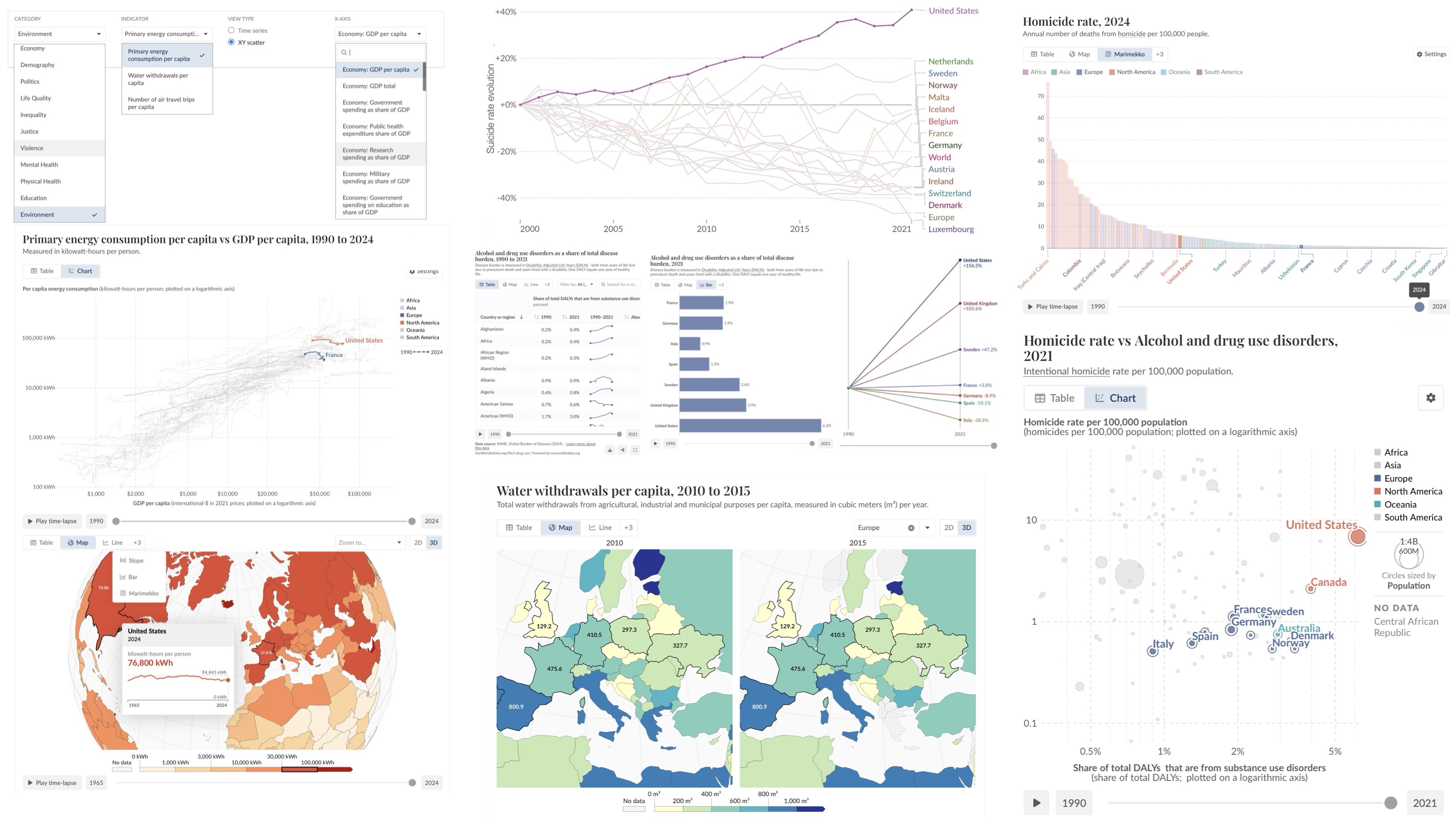
An interactive and user-friendly platform that aggregates nearly 100 indicators across the many dimensions of society, enabling the exploration of over 10,000 potential correlations and any country's trajectory in this phase space through dynamic visualizations evolving over time.
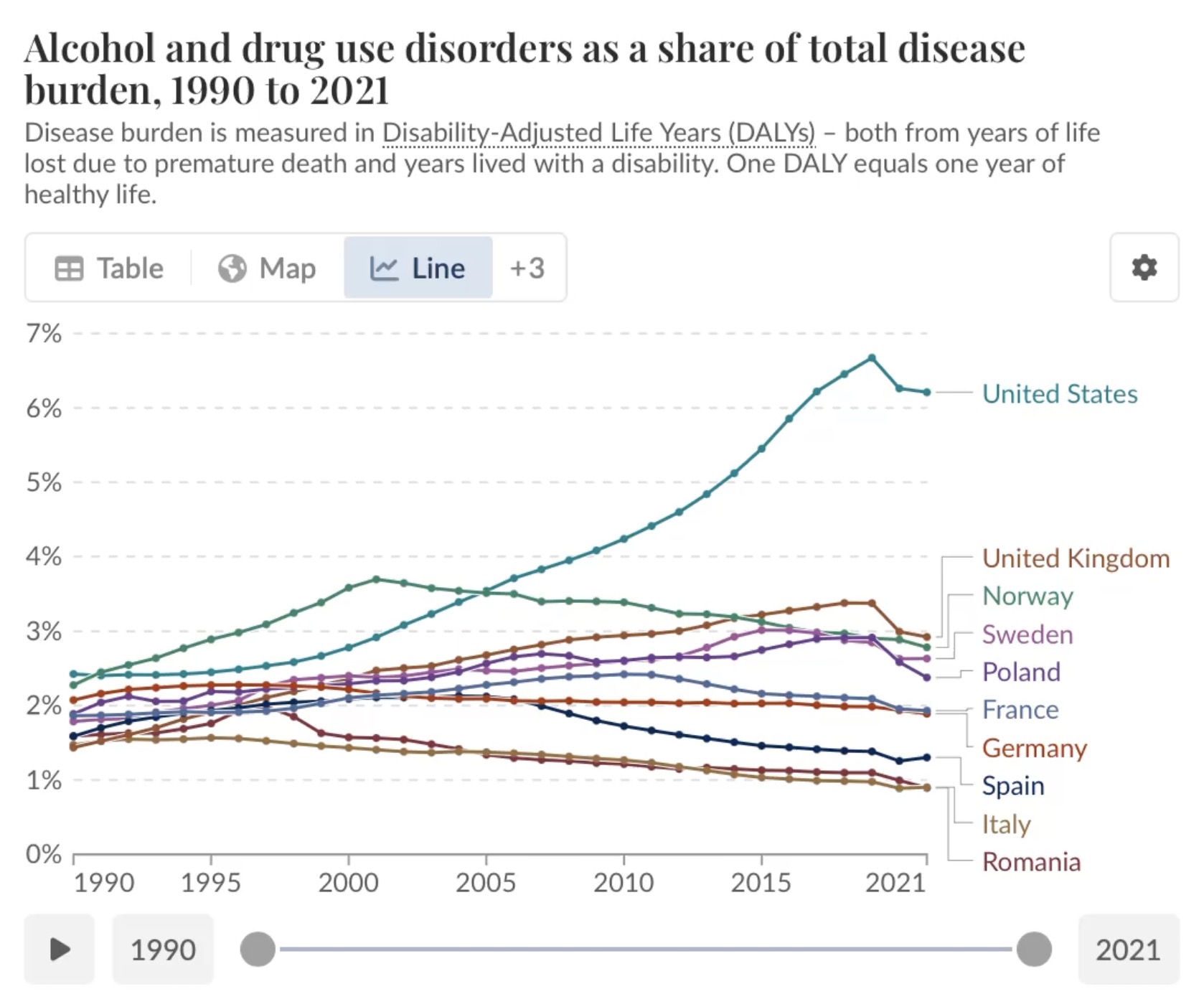
Track evolution over decades or centuries. Visualize absolute and relative changes. Identify structural trends and inflection points. Capability to add projections.
Compare countries across indicators. Rank performance. Examine convergence or divergence patterns. View the evolution of maps in 2D or 3D.

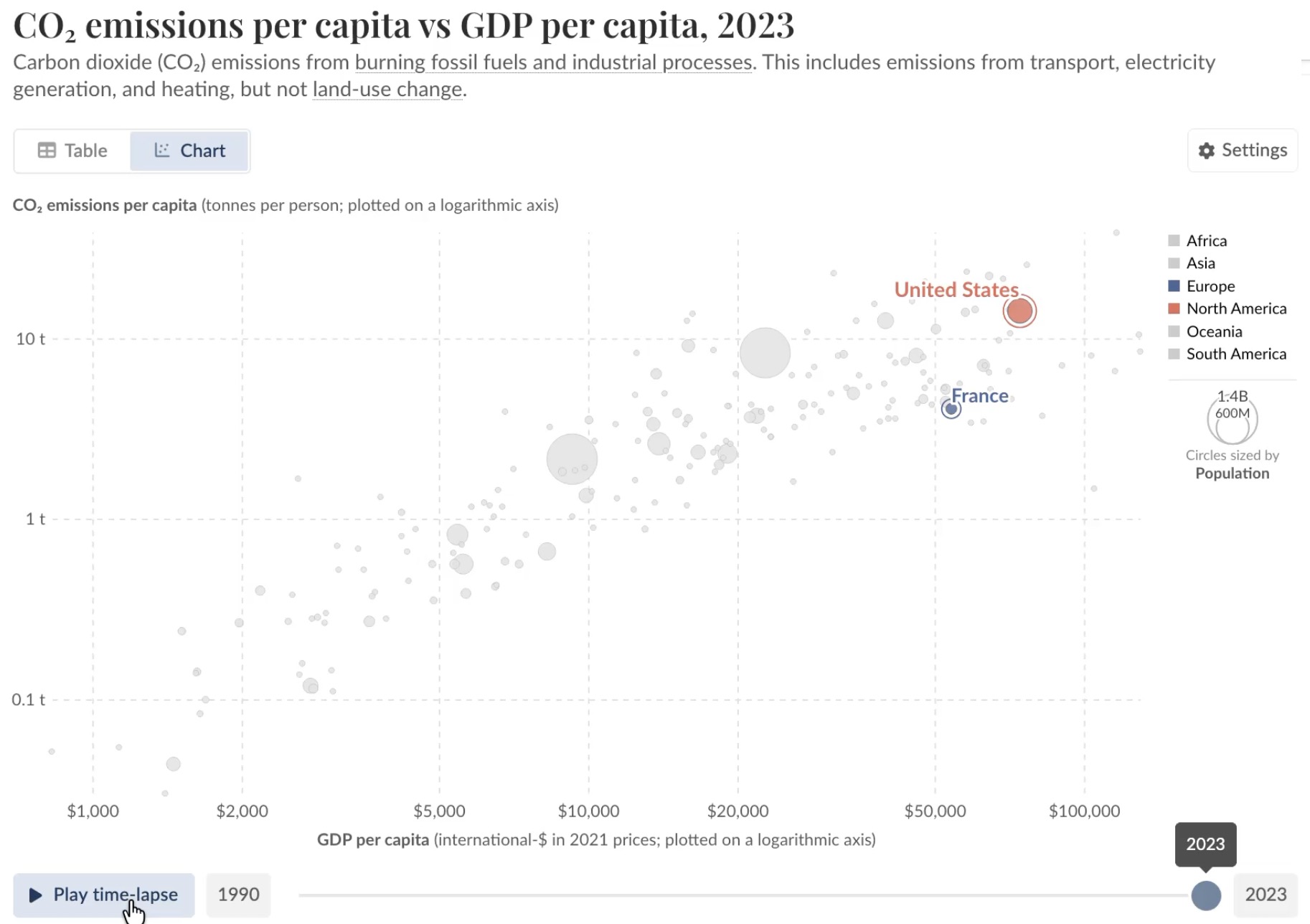
Plot any indicator against any other. Examine global correlations. Analyze individual country trajectories to understand how different policy frameworks produce different outcomes.
The crises and dysfunctions facing our societies — social, environmental, economic, political, media-related and ecological — are deeply intertwined. They can no longer be understood in isolation; like any systemic problem, they require a cross-cutting, systems-based view of how societies function and evolve.
Yet scientific production remains highly siloed. Today there is no observatory that allows genuinely transversal analysis of social, economic, health, institutional and environmental dynamics within a single framework. Quantitative analysis of societies is still largely dominated by econometrics: assessing a country almost exclusively by its economic performance gives a partial view and can help explain many of the dysfunctions societies face.
Understanding and addressing contemporary crises therefore requires breaking down disciplinary barriers and better grasping the interactions between these dimensions. Fortunately, since the late 20th century, the rise of the internet, open science, large global databases and international organizations has made an unprecedented volume of validated data available on nearly every aspect of human societies. International institutions (UN, OECD, World Bank, WHO), research labs and NGOs now produce detailed quantitative information on health, education, inequality, justice, environment, democracy and much more.
We therefore have both robust data and advanced technical capabilities to visualize them (international comparisons, time-series analyses, maps, dynamic trajectories, etc.) and to study them (multivariable correlations, causal modeling, projections, etc.). Yet holistic analysis of contemporary societies remains surprisingly underdeveloped in academic and public discourse: the data and tools exist, but there is no widely adopted platform to cross-reference, explore and interpret them together.
The purpose of this observatory is to address that gap: to provide an open, user-friendly and scientifically rigorous tool to visualize, compare and analyze a broad set of indicators covering the main dimensions of societal functioning.
In an era of information crisis and rising misinformation, such a tool can help re-anchor democratic debate in accessible, verifiable facts. Securing consensus around basic facts — the measurable state and trends of our societies — is essential to enable informed, durable and constructive public discourse.
Data is never neutral. Statistics can be used, misused, or instrumentalized to influence public opinion. Sources must always be verified, methodologies examined, and potential biases understood. Data can serve both emancipatory and manipulative purposes, so better be careful.
Correlation does not imply causation. While this observatory reveals patterns and associations between indicators, establishing causal relationships requires rigorous analysis, controlled studies, and careful interpretation of temporal sequences and mechanisms.
While social models can reveal patterns and even make some predictions, Human sciences fundamentally differ from exact sciences. Unlike deterministic physical phenomena governed by universal laws, human societies are shaped by irreducible historical contingencies, cultural specificities, and complex interactions that resist complete formalization. Models remain approximations—useful tools for understanding, not absolute predictors of societal behavior.
For feedback, collaboration inquiries, addition of indicators, or technical questions: mso@picouet.fr
We're seeking partnerships with foundations, educational institutions, and policy organizations to maximize the impact of this observatory.
Organizations interested in deploying this platform with custom data are also welcome to reach out.
This observatory is free and independent. If you find it useful, consider supporting its development.
Support the projectThis observatory builds on OWID's great work. Data sources include UN agencies, OECD, World Bank, WHO, World Inequality Lab, and other recognized institutions.